
Listen in as Equitable Advisors partners with Barron’s Advisors in a podcast series.
Hear about
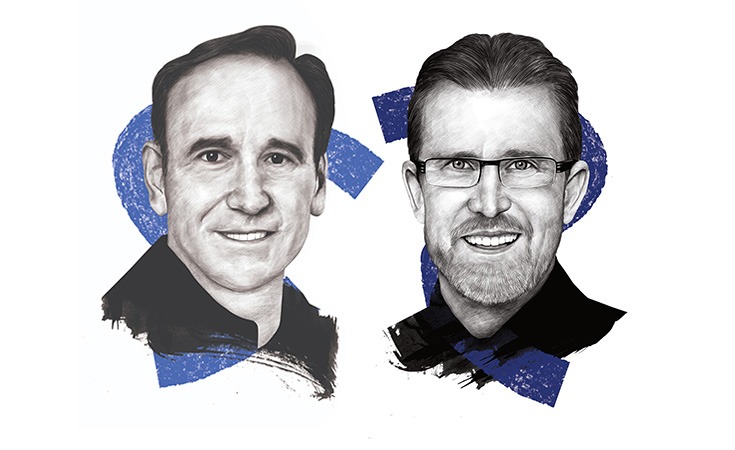
Anthony on setting out to build his team
Mike on succession planning
The advisory business is changing rapidly, and firms are being tasked more than ever to balance two overriding goals: grow their business and serve their clients efficiently with a holistic, personalized approach. Two advisory team principals, Anthony Villari, Managing Partner at Karr Barth Associates, Private Client Group Advisors, and Mike Sufficool, Managing Partner at RaiStone Wealth Partners, recently came together to discuss how they organized their staffs and operations with the support of Equitable Advisors to help ensure business growth while also putting into place a strategic plan for succession.
Anthony Villari: Mike, it’s great to talk with you. Over the years, I’ve been to a lot of conferences Equitable Advisors has
Podcast transcript:
Anthony Villari: Mike, it’s great to talk with you. Over the years, I’ve been to a lot of conferences Equitable Advisors has sponsored. It’s given me the opportunity to collaborate with other team leads across the country, which is great. And it’s meaningful.
Mike Sufficool: Great way to put it. It is collaborating. You get some ideas that make you think outside the box. So Anthony, I’m curious to hear how you got your start.
Villari: I started in the business in 1990. I had a public accounting background, so most of my leads and opportunities came from CPAs and tax preparers. In the late ’90s, the accounting and legal professions started to allow multidisciplinary practices, which meant accountants were able to be licensed in our business to sell securities and insurance. And so my regional office tapped me to run that district.
Five years into that role, I decided I wanted to get back into individual production. I joined up with a young associate, and we started to do joint work together.
In 2007, Equitable Advisors sponsored folks to come in to talk about teaming at our local complex. So I officially started a team around then. I made a formal arrangement with my business partner, and we started working together. Soon enough, you realize that focusing at a high level across all branches of finance is really difficult. So I set out to build our team with individuals who had different skill sets. Today, we have 12 producers in our group.
What about you? What was your start like?
Sufficool: I began working as an individual practitioner in 1992. And then quickly, I got promoted into management and got involved in recruiting and training new financial professionals, advisors and people coming into the industry. So over the years, I’ve had the opportunity to bring on board a lot of great talent. And as our business grew together, we got a lot of opportunities to do joint work.
Along the way, Equitable Advisors came out with this great concept of “producer groups” that work in alliance with the broker dealer. My team and I really got to unpack that and said, “OK, what’s different about our group, if we were to formalize into an actual producer group?”
We had a lot of conversations with individuals that I know, like and trust. And so when we sat down, we said, “What’s going to make us unique? What’s going to be different about this?”
Villari: What year did you officially form your producer group?
Sufficool: 2017. It was just me and my four other partners. Since then, we’ve added quite a bit more staff and 10 more affiliates. I liked what you said about joint work, because that was the beauty of our group early on.
I find that with the way we built our staffing model, I actually get calls now from my clients, and when I pick up, they go, “Oh, no, I didn’t want to talk to you, I wanted to talk to Stephanie.” I’m like, “Wait a minute.” And they go, “No, no, they’ve got me covered.” Life just seems to be getting easier and easier, because we’re learning. You know the old adage: “Smart people learn from their mistakes, but smarter people learn from other people’s mistakes.”
Villari: Right.
Sufficool: I started attending meetings through Equitable Advisors’ Elite Advisors Group, which provides advisory firms support programs on operational efficiency, talent development and technology integration. And to hear from these individuals, “Yeah, we tried that, Mike. Don’t do that. Try it this way.” It’s been great from a staffing role standpoint. So you guys share your staff as well? How does that work?
Villari: We have four full-time staff who focus on particular areas. And then we have a full-time financial planner.
One of the common tasks our team is asked to do is preparing a proposal or presentation to suit a client’s needs when a lead or opportunity arises. But we’ve always been able to do that, as you know. Through Equitable Advisors, we have an open architecture that allows us to do what’s best for the client.
I’m sure it’s worked the same in your office, but in my 35 years, no one has ever told me, “Hey, you need to place this business.” We’ve been able to go out and find the product that really fits the client’s needs. So that takes time and effort.
Building up our staff in that area is going to be the next area where we need to go. How about your staff? How many members do you have?
Sufficool: We have multiple offices in three different states: South Dakota, Iowa and Nebraska. We have financial professionals who just plug into our staffing model, either just for new business or for service, if they have a big book of business—or they can do both. We’ve structured it in such a way that it becomes incredibly efficient. You can join our group in any way and get a staff of approximately eight people.
Villari: That’s great. A few colleagues in the office outside our team have tapped into the service model that Equitable Advisors has created, in which you can communicate with a remote service provider who’s fully licensed—and really, at a fraction of the cost of a full-time assistant. I think we may take a look at using that through the Advisor Assist Premier program. It has been a highly efficient way to add staff.
So what do you see as next for you?
Sufficool: Today’s world is all about immediate response, immediate feedback, right?
That’s one of the things we pride ourselves on here. I kind of joke, I always tell my clients, “If you call, email or text me and don’t hear from me, usually within minutes, but definitely within 24 hours, I died—or I didn’t get your message.”
What we’re trying to build better here is making sure we get ahead of the growth curve and have a sufficient staffing model. The biggest thing we’re working on right now is how to make existing financial advisors run their practices more efficiently. We have the support that gets it, but exchanging ideas with guys like you is going to help me a lot. How about you?
Villari: For the last five to 10 years, as leads and opportunities came into my book that didn’t meet my sweet spot, I was able to push them down to the other producers. But now, I’m not that comfortable pushing those leads down to the other producers, because they’re pretty busy themselves.
So we’re in the process of looking at newer associates who are in our region. The wonderful thing is that we have a half dozen district managers who are recruiting new and experienced hires for Equitable Advisors. The advantage there is that they’re helping train and coach the newer associates. This creates potential future advisors who can join our group.
As our businesses have grown, many of us are just looking to add a few new good clients a year, given our large existing book of business. If we can provide that great service, we know that we’re going to get more leads, which will enable us to help some of the newer members of our team generate opportunities.
Sufficool: Anthony, I’m curious to hear how your business is thinking about succession planning.
Villari: I have a joint partner agreement (JPA). I still need to do a little more work in that area. But I would say 80% of the firm members have JPAs right now. How are you thinking about succession?
Sufficool: Equitable Advisors’ succession planning group is phenomenal. They really worked with us. When we did this at RaiStone, we actually put an operating agreement in place. We sat down with an attorney to create an operating agreement, because I saw producer groups struggle. And then, what happens to the practices? I’m in the middle of taking over a practice from a representative who used to be with us, and I’ve retained 100% of the clients because of the continuation systems we have, and just to be able to say, in the same language, “Here we are.”
When we were doing our JPA, they said, “Ah, I don’t think you want to do that. What if you do this?” I was like, “Yeah, that makes total sense. Why wouldn’t we do it that way?” So I think we’re 100%. All of our people have JPAs. We’re ready to roll.
Villari: Nice.
Sufficool: Yeah. They’re terrific. Do you do much in the way of visiting with firms outside of your team? Are you guys looking to bring anybody on that way?
Villari: I have one prospect from a local club where I’m a member. There are plenty of advisors out there who are operating individually without a lot of support. So there’s a good opportunity to share with them how our team operates within Equitable Advisors.
Sufficool: I always love having those interviews with people, just to find out what else is out there. You got to keep your eyes and ears open, and it’s kind of refreshing when I have those conversations to say, “Wow, we actually have it pretty darn good here,” when you start to tell people little pieces here and there. It’s a lot of fun with Equitable Advisors, without a doubt.
Villari: Well, continued success, Mike.
Sufficool: And the same to you. I’m looking forward to more conversations.
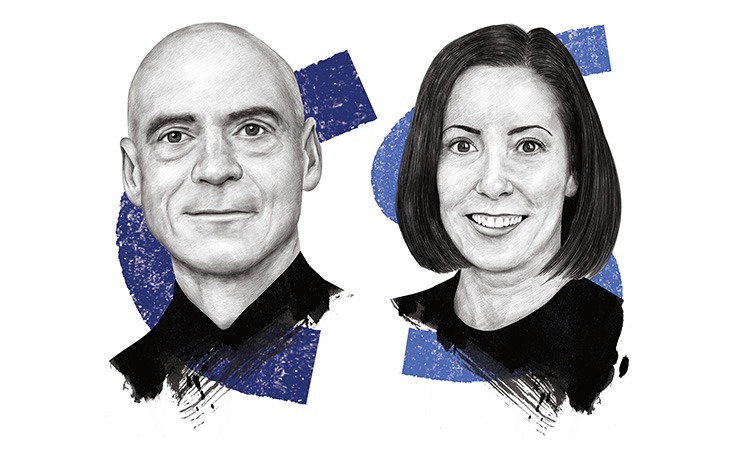
Jennifer on building strong relationships
Jim on the core elements of success
What are the secrets to success in building and sustaining a wealth management business? Jim Mellin, President of Advice and Wealth Management at Equitable Advisors, and Jennifer Littlefield, Managing Partner of Impact Wealth Management and a top 10 woman advisor within Equitable Advisors, recently shared what is most critical in developing practice excellence, including having a growth mindset, establishing a clear vision for the values and goals of the firm and encouraging more women to pursue advisement careers.
Jim Mellin: Jennifer, I’ve been impressed with the current state of your business, the team you’ve built, the structure of...
Jim Mellin: Jennifer, I’ve been impressed with the current state of your business, the team you’ve built, the structure of your team and the impact you have on clients. You’re one of the top 10 women advisors among all Equitable Advisors in the U.S., with over $600 million AUM. But it’s always a journey. I’m super curious about your story.
Jennifer Littlefield: I started with Equitable Advisors about 12 years ago, committed to making my practice a success. Early on, Equitable Advisors provided the foundational things I really needed to learn. Because I got off to such a great start, they introduced me to my mentor, a woman who had been in the business for 37 years and who I acquired this practice from. That mentorship catapulted me to where I am currently. Some of the critical things I learned from her were the importance of focusing on building strong relationships with clients and how to plan for a succession that can lead to a proper transition.
Mellin: Can you talk about how you moved from acquiring a practice to building and integrating a successful firm? What was that like?
Littlefield: Obviously, we were a small firm before—there were three of us, and then two of them retired. That was a really great opportunity to build the team I wanted and turn it around from an individual’s practice to a team-based practice that would live indefinitely based on our core values, which were commitment to the client and commitment to financial planning and upholding a very high moral standard for our team members.
In year two we start moving. We had two other senior advisors and me, and one junior advisor. Fast-forward one more year, and we’ve gained one more junior advisor we were also doing some joint work with who met our standards and seemed like a good fit. So that’s where we are today: three senior partners and two junior advisors.
Mellin: I hear people talk about the desire to have a true team that integrates. And as I listen to you talk about the inception of this firm, it feels like you built a foundation of a shared vision right at the outset.
Littlefield: It was very important for us that we took a financial planning approach with our clients and had a very high bar for the promises we would deliver to the clients. And so we decided to focus on having a certified financial planner designation for all of our advisors and to act as a fiduciary for our advisors. What we really wanted to be was one of the leading financial planning firms in our area.
Mellin: What is impressive to me was how sophisticated your team has become about providing value. Can you walk me through how you built that and what advantage that provides for clients?
Littlefield: One of the keys to my success has been delegating early on. When you’re doing a lot of different things and you’re spread very thin, you’re not doing a great job at anything. You’re just doing a lot of stuff. And so we have different committees across the firm—investment, financial planning, team events and so on—and all five advisors who are on our team have responsibilities across a couple of different committees. It really lets us home in on our distinct processes to accelerate and enhance our client experience and build in the systems that would support that from the client level.
Plus, we have a team of seven support staff. I think our support-staff-to-advisors ratio is heavier than most folks I talk to. But for us, it’s just been the way to grow quickly. This was purposeful so we could focus 100% on client engagement and elevating the practice, and delegate everything else to the staff.
Mellin: Did your team go through the formal Equitable Advisors teaming program?
Littlefield: Yes, we did. It just opened our eyes to what other successful firms were doing. We got some great coaching, and it let us think about the big picture. We got to brainstorm: “What do we want? What’s important to us? What do we want this firm to look like, not only now but five years, 10 years down the road?” We got a lot out of that process and continue to use the firm’s Elite Advisory Group (EAG) as a strong resource for our partnership. I also sit on the National Associate Forum (NAF) and get to have direct input on company decisions that impact our businesses each and every day.
Mellin: We are very proud of NAF, with which I partner to help shape the future of Equitable Advisors. Additionally, we see the EAG Steering Committee, which is really for principals of firms like you, as one of our key differentiators, providing another level of feedback, input and support. Senior advisors, like you, are gaining knowledge from firm members who may be five, 10, 15 years ahead of you, and you’re asking them, “How did you deal with this?”
Littlefield: That support and insight have been invaluable. What I’ve seen and appreciated over the years is the openness and willingness of other advisors who are much more successful than I ever was in the early stages to talk to us and spend time. No one I’ve ever reached out to at Equitable Advisors has ever said no to “Can I pick your brain at a conference? Can I follow up with a one-on-one call later?”
Mellin: That’s deeply ingrained in the Equitable Advisors culture. A unique element of our value proposition is that we will bring in 600 to 700 brand-new advisors per year, and that ends up being a fertile ground to develop joint work relationships, with the potential for advisors to eventually join a firm or team. It seems like everyone in our organization benefits from the wisdom, advice, caring and process from those who started before us.
Littlefield: What other key things do you view as being successful for other firms like ours?
Mellin: We’ve developed 11 elements to provide guidance on the core elements of success | LISTEN that align with planning, process and people. We provide them to all of our teams. And our drive is to partner with that firm lead, as you know—identify what their vision is, figure out what their sticking points are and then help them grow. And every step of the way, they’re getting connectivity and interaction with other teams. Jennifer, I’m curious about your view on other parts within Equitable Advisors that have helped your firm grow.
Littlefield: Equitable Advisors has a program where we partner with CPAs. It’s a huge piece of our business. About 25% of our new business annually is coming from my CPA relationships, so it’s been a focus of mine for many, many years—connecting with CPAs, sharing what we do with them and, over time, building these relationships.
Mellin: Here you are among the top 10 women advisors with Equitable Advisors, 12 years into the business. You’ve successfully gone through the acquisition of a practice, and now you’ve built one of the most successful firms in the country. What does the future look like?
Littlefield: We have a system that will continue for our younger advisors. We’ve already gone through selling off tranches of our clients to our junior advisors, so they get an opportunity to take over some of our clients and buy into a practice for themselves.
Additionally, acquisition is definitely on our radar. We’re looking for partnerships, to bring in an advisor who is looking for a team, a support system. We’re actively looking for more experienced advisors to join the team. Specifically, we are looking for women advisors.
Mellin: We think there is a massive opportunity for women advisors in the future. We know wealth management continues to be a male-dominated industry, but is it changing?
Littlefield: Acquiring my own firm was terrifying, exhilarating and very rewarding, all at the same time! I came in when my son was a year old. He’s now almost 13. At the beginning, I put in so much hard work, time and investment, and that has just completely paid off. You have the ability to create a business with the support of Equitable Advisors. It’s really your own, and you can create it based on your values and the way that you want it to be. And for me, as a woman advisor and a mom, it’s been fantastic.
Mellin: What you’ve done in 12 years is just extraordinary. Congratulations—and thanks for sharing it with everybody.
Littlefield: Thanks. I feel very lucky to be part of the Equitable Advisors team. I don’t think I would have had nearly the same success I’ve had without their incredible support. I had no idea what I was getting into when I started, but it’s obvious that I’m on this amazing journey.
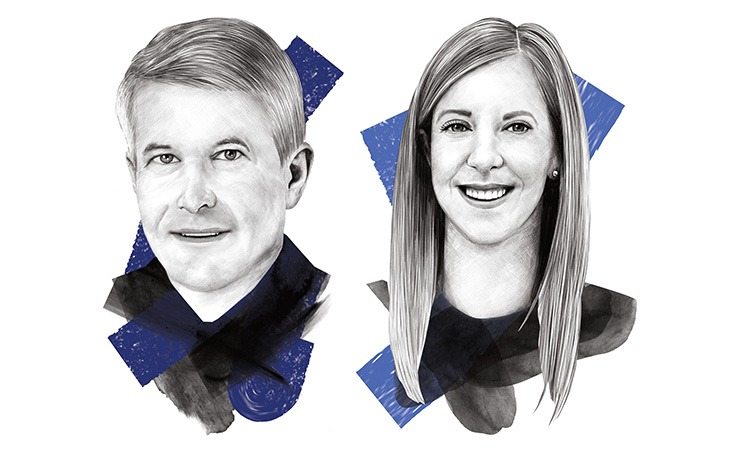
Podcast transcript:
Sarah Ogle: The opportunity has really never been greater for women to come into...
Podcast transcript:
Sarah Ogle: The opportunity has really never been greater for women to come into this career because so many women are needing what we do. They’re living longer. They are making more and more of the financial decisions in their household. I see more and more women interested in this profession.
Todd Johnson: It’s been really neat to see the support that’s there from Equitable Advisors to help women and to help other diverse groups get into the business and become very, very successful.
Ogle: Todd, I can imagine over the last 34 years you’ve seen a tremendous amount of changes. What are some of the biggest changes that you’ve seen?
Johnson: If I had to point to one thing, it would have to be technology. That has really enabled us to have access to more information and better information. It’s also helped us to be more efficient. Now we can work from our phones, that are much more portable and easier, and it’s easier to stay connected. And it’s also allowed us to do a better job for our clients and offer them better advice because of the tools that we have. What about you?
Ogle: I remember being out in the field meeting with clients and filling out a 40-page paper application with them.
Johnson: Painful.
Ogle: And I think now, just based on the technology that we have, and even fast-tracking that during COVID with being able to do those virtual meetings, tools like Asset-Map where it’s really visual and easy—a lot of my clients love that, and I can put it up on the screen and interact with them.
Johnson: Talking about the 40-page application, I can remember those days, but thankfully, we rarely touch a piece of paper now. I think Equitable Advisors has done a great job of giving us the tools and resources we need to build our practices and to operate even more efficiently. The new marketing suite is something that we’re really excited about. It enables us to set up those regular touches to our clients that are personalized.
Ogle: We are doing something with a marketing suite right now around an event that we’re hosting, and I love that I can send out the invites, get RSVPs and everything through that centralized tool. What do you think has really helped lead to that success and then ultimately, your transition and building the team that you’ve built?
Johnson: I think first, having a great trainer, having a great manager that was willing to, I think he used to call it sewing our shirt sleeves together. He taught me how to find clients, how to network. And in 34 years, thankfully, I’ve never made a cold call. I’ve done everything through referrals and just getting involved in things that I enjoy. Equitable Advisors has really done a great job of helping initially build a marketing and a business plan and then giving me the education and the training to become a successful advisor.
Ogle: For me, hands down, it’s the people. One of the reasons why I wanted to join Equitable Advisors was really, first and foremost, the people. Everybody I met when I was trying to decide where to go, I could tell that they genuinely loved what they did. I remember starting out in this career and looking around our office, and I think I saw maybe two other women, and they were phenomenal. And now, after being here for 16 years, I have seen this growth in women coming into this career.
Johnson: It’s been really neat to see the support that’s there from Equitable Advisors to help women and to help other diverse groups get into the business and become very, very successful and build teams and organizations. We get resources and training constantly to help us build our firm and grow our firm and also create succession plans for those next generations of clients and advisors coming into the practice. And I know in your role as a leader, you see that every day. What’s been your experience with the resources that we have to build teams and firms?
Ogle: We believe so much in teaming. From day one, an advisor is connected to a team that comes in inexperienced. And again, as a district manager, I always told my new advisors, you’re mentored by me, I’m your built-in mentor, but you’re also mentored by our entire team. So I would love to hear more about what that experience has been like for you and now building your team. And I think that you’ve brought your son into the business as well.
Johnson: We have 10 advisors right now with one new advisor coming on board. And then my son is actually a senior in college and we’re in the process right now of working out that transition plan for him. But it’s been a lot of fun to build a team. We have different talents and different skill sets, and so we’re able to really address all of our clients’ needs in a better way and provide the expertise that they need in different situations. I think our youngest right now is 28 and our oldest is 67, so it’s a good age range.
Ogle: That’s fantastic. So do you feel like having that big age range within your team has helped really bring on more clients and different next generations within your client base as well?
Johnson: Absolutely. Equitable Advisors does a really good job of giving us an opportunity to bring new people in and to mentor them, but we’re not responsible for everything. They actually provide the training, the support, the education, the accountability, and we provide our years of expertise and knowledge. And our clients have really responded very well. They want to make sure that there is continuity. If I decide to retire and move to the beach one day, there’s somebody there that’s competent, that’s really good, maybe even better than me, that’s going to take care of them and their businesses and their families. And I think that supported independence model of owning your own practice and having an open architecture, providing the best advice to the client, and then being unbiased in the recommendations that you make is so key. Sarah, what’s your approach to working with clients? What do you think is key in those initial relationships?
Ogle: I have always found that developing trust is the most important thing, and really getting to know them: who they are as a person, not just their finances, and what’s most important to them. Who matters most? What goals do they have? What dreams do they have? And then I think the other really big thing is staying in touch and having a system to stay in touch with clients because so often you’ll hear from clients, “This advisor was great until we did business, and then I didn’t hear from him again.”
Johnson: I think a lot of advisors are great at getting that client relationship and then they don’t do a great job of servicing that client. We have really good tools to stay in touch with clients.
Ogle: How do you feel like having the diverse team that you have, from age ranges and male/female and ethnically diverse, has helped you serve clients in a more holistic way?
Johnson: We want to be able to understand and have empathy. And I think one of the best ways to do that is for our team to be a reflection of the community. So that’s something that we’re constantly working toward, and I think that makes us all better and helps us serve the community in a more impactful way. I know in our firm, it’s been great to be independent, but not to be alone. And to have those resources to cover us and to help us, whether it’s compliance or marketing or education, it really makes us better advisors and also helps our clients.
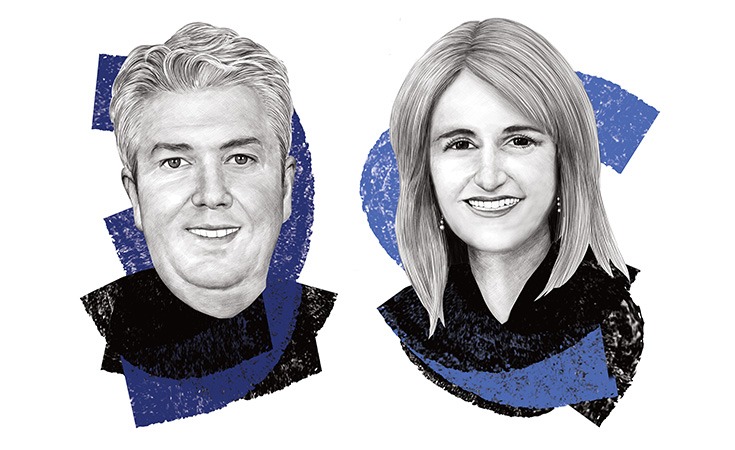
Podcast transcript:
Bill Degnan: I think we’ve been ahead of the curve, and I think that became pretty apparent...
Podcast transcript:
Bill Degnan: I think we’ve been ahead of the curve, and I think that became pretty apparent during the COVID years when we were really prepared from a technology standpoint a lot better than a lot of our competitors. And I think that really gave us all maybe some conviction that, well, we’re the right team at the right time. How about you?
Cindy Price: I tell my clients that I work in alliance with a large broker-dealer that’s one of the largest in the nation, but yet I’m able to have my own d/b/a—Price Financial Services—and operate my practice in the best way possible for my clients. And then, with all the tools that are available on our desktop, I really feel like I spend 80% of my time in front of the client, and that really is a good feeling.
Degnan: One of the real differentiators I find between Equitable Advisors and other firms is the culture. And it’s not just the local culture or our office culture, but I think the corporate culture is not one of, no, we can’t do that, or here’s the reason why we can’t proceed. There seems to be a real culture, which has been prevalent as long as I’ve been here, which is really what’s best for the client, what’s best for our advisor, and then how do we make that happen? When you’re an advisor today and your goal is to build an independent business, I think that a lot of people find that it’s really rewarding to have a great corporate partner that will let them function independently. When you think about where your practice is headed and the things that are important to you and your clients, what do you see?
Price: I see that people are interested in the whole picture and holistic planning and growing their wealth, protecting their wealth.
Degnan: Yeah, I agree with that.
Price: Keeping up with inflation, the idea of longevity and they want to know, I want to make sure that my money outlasts me and that I leave a legacy as well. And I really think that the personal financial planner is not going away, because people really do want personalized advice because everybody’s different. I mean, your practice is different from my practice, and that’s what’s so neat when we go to conferences and we meet people, other advisors, that have completely different business models than we do, but somehow Equitable Advisors’ system is able to support whatever that is.
Degnan: In my role as a leader, I’ve had the opportunity to talk to and to bring advisors into Equitable Advisors from other firms. And what I find interesting is that there’s three things they’re always looking for. They’re looking for technology upgrades, they’re looking for mentorship and coaching, but they’re also looking for holistic planning for their clients. More and more, as clients are getting more savvy and are getting more mature financially, they’re looking for an advisor and a firm that’s committed to holistic advice. And what I’m finding with these advisors outside of our firm that are interested in joining us or have joined us, is they don’t necessarily want to change what they’re doing or what they specialize in, but they do realize their clients have other needs and they need resources to address those, like estate planning, like wealth transfer, like corporate benefit planning. If you look at the tools—our aggregation tools—some of the financial planning tools you mentioned and our CRM, it’s all about being able to address a lot of needs for the client or at least be able to have a resource for the client around those needs.
Price: You’re in a branch location where you have support there if you need it, and people get to be mentored by you, which is great. At the same time, when I started a family 25 years ago, I wanted to be closer to home, so I was able to open up my own smaller office, but I get to still see people from the branch and with our meetings. And then I have my study group, which is the other Top 5 women in the country, and we can share ideas. And I think that being a part of Equitable Advisors really becomes like a big family and they’re there to support you with whatever is happening in your own personal life. And so, fortunately, again, you may have experienced the same thing. It’s like an extension of the family. I was fortunate to be able to write a book, and in that book I talked about life transitions and that there’s always money in motion; people are going through a divorce or they just got laid off from their job or their parents passed away. And I started to have a lot of clients go through divorce or lose a spouse. And so I started to utilize all the resources that we had to help those people. And then I had my own life transition two years ago when, after 29 years of marriage and on a wonderful all-inclusive vacation with our best friend couple, my husband passed away the last day of our vacation of a heart attack, and so it was devastating. And then, about six months later, my business partner, who we had been together for 15 years, he passed away suddenly. Didn’t come into work. And so we had, with the support of Equitable Advisors, everything in place. We had been mentoring younger folk to do the same job that we are doing. And so it’s been a seamless transition. Our clients definitely enjoy the fact that they can see that there is continuity and also see that there is some youth and innovation going.
Degnan: Cindy, you mentioned that you’ve got a study group that you get together with the Top 5 women in the firm in the country. Can you tell me a little bit more about that?
Price: When we get together virtually and also in person, we are able to share best practices with each other and also walk through some of the stages of life. We’re able to share how we are guiding our clients through their life transitions and also how we’re doing that in our own practice. For example, I specialize in women in transition through widowhood and divorce, and also couples that are employees of major corporations in town. Other women advisors that I know specialize in working with business owners, women business owners. And we know that women are starting up businesses at a record pace these days. And so as we see women advancing in the population, then we as women advisors have the opportunity to come alongside them and guide them.
Degnan: There’s a lot of money that women are in charge of within the family structure, and getting more and more women on the advisor side is really aligning with the goals and culture of our clients and what it is that they want in an advisor.
Price: I think that a woman becoming a financial planner has so many advantages because you want to help your clients implement what you’ve already implemented yourself.
Degnan: I think the greatest financial advisors in the industry are looked at as a resource—period. Many clients, they are looking, they’re really measuring, I think, our worth on the value we bring. And it comes back to being more than just somebody that manages my money and helps me with wealth creation. I think that culture is really what differentiates us. Equitable Advisors is committed to holistic planning.
Price: I heard about how you had brought in a large team. For a team to make a decision to come over to Equitable Advisors was obviously a big decision. Can you tell me a little bit about why they chose Equitable Advisors?
Degnan: We’re very, very excited about this team. They’re a very large firm from an assets-under-management perspective, but what really came down in their decision-making, number one, was culture. They met our corporate leaders. They had family in common. What I mean is their families were important to them, and our leaders’ families were important to them, and being able to talk about that. The other thing they were struck by was the number of people they met, not only in leadership, but also our advisor ranks where they had been with our firm 25, 30, 35 years and saw great value in the model and were very loyal to the model and saw great value to their clients in the model. And then technology was another big piece that they were looking for, as to upgrade technology, have the technology that clients not only expected, but that top advisors expect today from their business partners. And then I think, lastly, they’re interested in providing more services to their clients on more of a holistic platform. And after doing their research, they really felt that Equitable Advisors with supported independence was really the model that could take their practice to the next level.
Price: Bill, this new team that you brought on, I’m sure they feel very welcome to the Equitable Advisors family.
GE-8774642.1 (01/2025) (Exp. 01/2030)
Privacy and security | Usage agreement
© 2026 Equitable Holdings, Inc. All rights reserved
The content of this website does not constitute an offer of investments, insurance, or financial advice and makes no direct or indirect recommendation with respect to the appropriateness of any particular product, investment, investment-related option, or financial service. Unless otherwise noted, references to “Equitable” within discussions of proprietary insurance and annuity products apply specifically and exclusively to issuers Equitable Financial Life Insurance Company (Equitable Financial) (NY, NY) and/or Equitable Financial Life Insurance Company of America (Equitable America), an AZ stock company with an administrative office located in Charlotte, NC. Overall, Equitable is the brand name of the retirement and protection subsidiaries of Equitable Holdings, Inc., including Equitable Financial, Equitable America, and Equitable Distributors, LLC. Equitable Advisors is the brand name of Equitable Advisors, LLC (member FINRA, SIPC) (Equitable Financial Advisors in MI & TN). Equitable Financial, Equitable America, Equitable Distributors, and Equitable Advisors are affiliated companies and do not provide tax or legal advice or services. The obligations of Equitable Financial Life Insurance Company and Equitable Financial Life Insurance Company of America are backed solely by their own claims-paying abilities. Equal Opportunity Employers (Equitable Financial Advisors in MI & TN). M/F/D/V.